How farmers can enhance agricultural efficiency and resilience – and how investors can benefit
Earth Day is a reminder of food and water scarcity. Technology is helping address the risks.
- Agne Rackauskaite and Justin Winter
- 4 min reading time

Source: Trustnet
Agriculture sits at the centre of global environmental challenges. As well as being the primary consumer of freshwater and a major contributor of greenhouse gas (GHG) emissions, the sector is also uniquely vulnerable to water scarcity and climate change.
Droughts, floods and storms – all intensified by climate change – threaten production and, ultimately, global food security.
To improve resilience and efficiency the industry is increasingly adopting innovative solutions that cut water use and improve yields, also limiting its environmental impact.
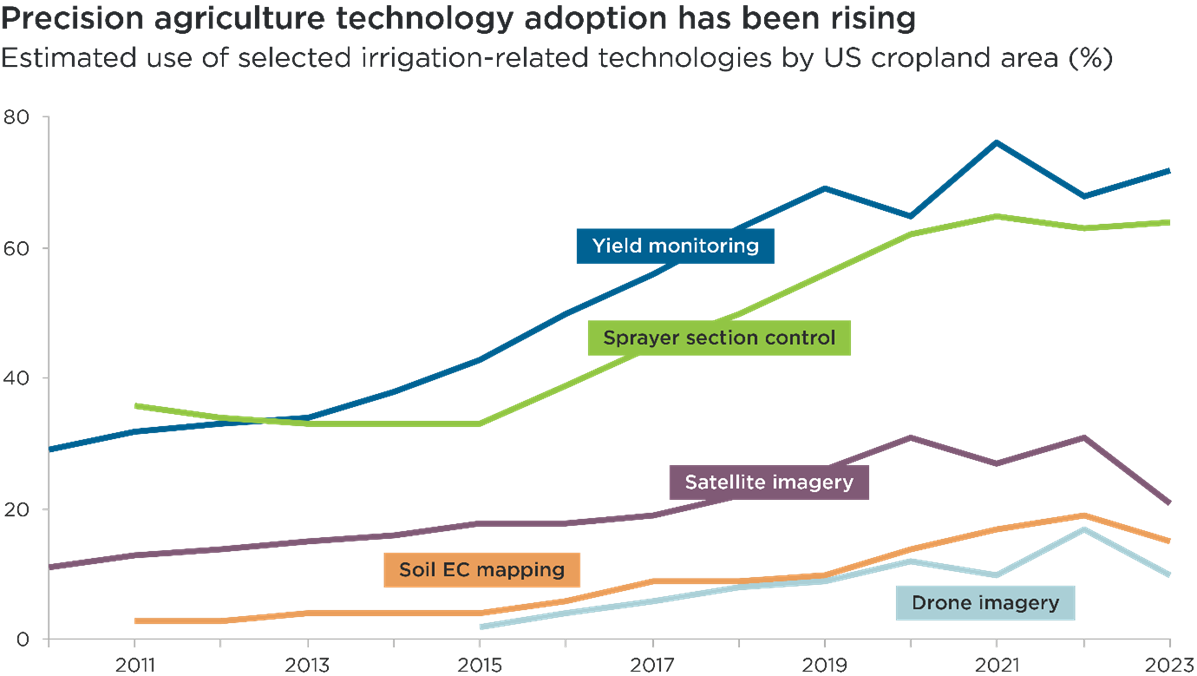
Source: Impax Asset Management
Making better use of limited water
Agriculture uses around 70% of global freshwater, much of it for irrigation in water-stressed regions. Three-fifths of the world’s irrigated crops are grown in areas where water supplies are highly stressed.
In arid and semi‑arid regions – from the Middle East to parts of Africa and South Asia – intensive crop production is placing pressure on rivers, aquifers and reservoirs.
These pressures are exacerbated by increasingly unreliable weather patterns and more severe droughts. Even traditionally reliable sources of freshwater, such as glacier meltwater, are under threat from climate change.
Farmers also face growing competition for water from expanding populations and industrial demand. This creates strong incentives to adopt technologies that reduce consumption and minimise losses.
Precision irrigation can optimise water use by tailoring both timing and volume to specific crop needs. When combined with sensors, automation and data insights, these systems can significantly reduce water usage, often by double‑digit percentages, while lowering operational costs.
Valmont is one of the market leaders in this space. Its advanced systems, including centre-pivot irrigation, are being deployed across water‑stressed areas to support more efficient food production.
In Egypt, for example, the US company’s technologies have been integrated into national programmes aimed at boosting water‑efficient wheat production in response to the disruption of global grain markets after the invasion of Ukraine in 2022.
Boosting crop resilience
Weather has always shaped food production but more frequent and intense extremes induced by climate change pose a significant threat to crop yields.
For producers, declining yields and less reliable harvests mean lower incomes, higher production costs and uncertainty about long-term business viability. Against this backdrop, seed innovation is playing a key role in adaptation.
Companies like Japanese-listed Sakata Seed are developing vegetable and flower varieties specifically bred to withstand heat, drought and disease pressures. By improving resilience at the genetic level, these seeds help farmers maintain yields under more challenging conditions.
Many of Sakata’s vegetable varieties require less water and fewer agricultural inputs than traditional variants, reducing dependencies on scarce resources while lowering input costs.
Reducing emissions and energy costs
According to the Intergovernmental Panel on Climate Change, agriculture is directly responsible for up to 8.5% of global GHG emissions. Policymakers in some countries have begun mandating reductions to align farming with national climate frameworks.
While climate policy remains uneven, farmers worldwide face an economic imperative to manage input costs amid elevated global energy prices. Energy can account for 40% to 50% of variable crop production costs in developed economies.
In this context, the adoption of more efficient agricultural equipment can improve margins and better insulate them from volatile oil and gas prices.
Alternative fuels also look likely to play an expanding role. AGCO, the world’s largest pure-play manufacturer of farm equipment, is developing electric powertrains and next‑generation engines for tractors, designed to be compatible with hydrogen and methanol, as well as diesel, lowering emissions and operating costs over time.
A growing market for solutions
We expect the industry’s vulnerability to water stress, climate change and volatile energy prices to accelerate the adoption of technologies that improve its resilience.
Demand should also drive further innovation, with emerging technologies enhancing the economics of farming and reducing its environmental footprint.
As pressures on scarce global resources increase, scaling these solutions will ultimately be essential to ensuring that agriculture can meet global food demands sustainably – and profitably.
Agne Rackauskaite is portfolio manager of the Impax Sustainable Food strategy. Justin Winter is portfolio manager of the Impax Asset Management Water strategy. The views expressed above should not be taken as investment advice.


Important legal information
Lloyds and Lloyds Bank are trading names of Halifax Share Dealing Limited. The Lloyds Bank Direct Investments Service is operated by Halifax Share Dealing Limited. Registered Office: Trinity Road, Halifax, West Yorkshire, HX1 2RG. Registered in England and Wales no. 3195646. Halifax Share Dealing Limited is authorised and regulated by the Financial Conduct Authority, 12 Endeavour Square, London, E20 1JN under registration number 183332. A Member of the London Stock Exchange and an HM Revenue & Customs Approved ISA Manager.

The information contained within this website is provided by Allfunds Digital, S.L.U. acting through its business division Digital Look Ltd unless otherwise stated. The information is not intended to be advice or a recommendation to buy, sell or hold any of the shares, companies or investment vehicles mentioned, nor is it information meant to be a research recommendation. This is a solution powered by Allfunds Digital, S.L.U. acting through its business division Digital Look Ltd incorporating their prices, data news, charts, fundamentals and investor tools on this site. Terms and conditions apply. Prices and trades are provided by Allfunds Digital, S.L.U. acting through its business division Digital Look Ltd and are delayed by at least 15 minutes.

Data provided by FE fundinfo. Care has been taken to ensure that the information is correct, but FE fundinfo neither warrants, represents nor guarantees the contents of information, nor does it accept any responsibility for errors, inaccuracies, omissions or any inconsistencies herein. Past performance does not predict future performance, it should not be the main or sole reason for making an investment decision. The value of investments and any income from them can fall as well as rise.
© 2026 Refinitiv, an LSEG business. All rights reserved.