The global sustainable fund beating the ESG blues
Co-manager George Crowdy highlights the importance of balanced portfolio construction to maintain returns.
- Emmy Hawker
- 5 min reading time

Source: Trustnet
Investor appetite for sustainable funds has cooled in recent years, with geopolitical tensions and economic challenges prompting even some of the staunchest believers in environmental, social and governance (ESG) themes to recalibrate their commitment.
As a result, sustainable strategies have faced sustained outflows. LSEG Lipper data published in January 2026 shows that UK sustainable funds logged an unprecedented fourth consecutive quarter of outflows in late 2025, with redemptions reaching £5.4bn in the final three months of the year.
Yet many sustainable funds have still delivered competitive returns.
Royal London Global Sustainable Equity delivered a top-quartile return in the IA Global sector in 2025, gaining 14.5% versus the IA Global sector average of 11.2%. It has beaten both the sector and its benchmark since it was launched in February 2020, gaining 114.2% over that time.
Fund performance vs benchmark and sector since launch
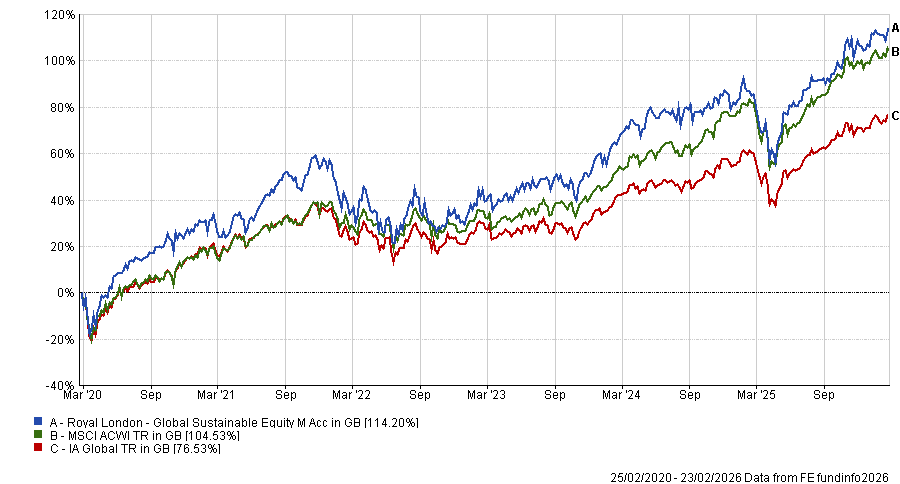
Source: FE Analytics
Below, co-manager George Crowdy explains how the fund has maintained its performance through a disciplined process, a global opportunity set and balanced portfolio construction.
What is your process?
At the heart of our philosophy is the belief that by looking at non‑financial and sustainable factors in our assessment of companies, we can identify businesses with underappreciated quality and underappreciated growth characteristics.
We aim to invest in companies contributing to a cleaner, healthier, safer and more inclusive society. That covers both products/services and operations. We are clear on where we won’t invest: if a company has any activity in conflict with those goals, we exclude it. We also have minimum corporate governance standards.
The outcome we aim for is a high‑conviction, balanced portfolio capable of delivering performance in as many different market environments as possible.
How do you balance sustainability criteria with fundamental criteria?
We balance sustainability characteristics and financial characteristics equally. However, in practice, we find that companies that are stronger from a sustainability perspective tend to be better businesses.
We often say the sustainability factors we look at are long‑term financial factors in disguise. The market inefficiency we try to exploit is time‑horizon arbitrage: over multi‑year periods, what a company does and how it does it are underappreciated signals of quality and growth.
Our sustainability research has two parts. Firstly, we look at what the company does, as we believe companies innovating to address society’s challenges should deliver higher and more durable growth. Then we look at how the company operates across governance, human capital, environmental footprint, customer and community impact.
Some regions are further along in their sustainability journey than others. Does this factor into where you look for investment opportunities?
No, we take a company‑first, country‑second approach. We care far more about how it actually makes money and how that compares with the alternatives available to us.
Although sustainability is more advanced in some geographies than others, we try to take a genuinely global approach to sustainable investing, as sustainability challenges are global in nature. We find that distinguishing between ‘developed’ and ‘emerging’ markets is increasingly difficult.
But there are certain geographies – particularly some emerging markets – where we struggle to find companies that meet our corporate governance requirements. Conversely, Europe and the UK have world‑leading sustainability disclosures, which help us build conviction. Beyond that, we are largely agnostic.
How have you navigated the heightened market volatility and the broader slowdown in appetite for sustainable strategies in recent years?
Since launching the strategy in February 2020, we have had almost every type of market environment.
Many sustainable funds have had more of a quality/growth bias during a period in which value and cyclicals were stronger.
A key lesson we have taken from this is that you don’t want a fund dominated by one style, risk or geography. We have tried to build a balanced portfolio – growth versus value, sector exposures, geographies and lifecycle stages.
Although there has been an ESG backlash and volatility in regions like the US, we haven’t seen companies change what they do. Disclosures have decreased in some cases but operationally nothing has changed. That’s because sustainability is simply good business practice, strengthening long‑term growth.
What was one of your best calls for the fund last year?
In these periods of market volatility, we try to be on the front foot. In April last year, following US president Donald Trump’s Liberation Day tariff announcements, we materially added to our position in Comfort Systems.
The company employs around 23,000 skilled tradespeople – plumbers, electricians, mechanical engineers – who are critical to the build‑out of physical infrastructure in the US, from data centres to semiconductor fabrication plants.
We were adding at around $300 per share and it is now above $1,100 – roughly a 350% return since those additions.
For the calendar year of 2025, Comfort Systems contributed around 4.5 percentage points to portfolio performance. That’s likely our best call of the past 12 months.
What was one of your worst calls for the fund last year?
One detractor in the portfolio has been Shimano, the Japanese bicycle‑components manufacturer. It is a leader in what it does but demand boomed during the pandemic and has taken a long time to normalise. The stock is down about 23% since the beginning of 2025, creating an 80-basis point performance headwind for the fund.
We have owned both Shimano and Comfort Systems for multiple years. As always in fund management, the goal is to make more from your winners than you lose on the positions that don’t work out.
What do you do outside of fund management?
I have two young daughters who keep me busy and I enjoy getting out into nature – especially mountain biking when the weather improves.



Important legal information
Lloyds and Lloyds Bank are trading names of Halifax Share Dealing Limited. The Lloyds Bank Direct Investments Service is operated by Halifax Share Dealing Limited. Registered Office: Trinity Road, Halifax, West Yorkshire, HX1 2RG. Registered in England and Wales no. 3195646. Halifax Share Dealing Limited is authorised and regulated by the Financial Conduct Authority, 12 Endeavour Square, London, E20 1JN under registration number 183332. A Member of the London Stock Exchange and an HM Revenue & Customs Approved ISA Manager.

The information contained within this website is provided by Allfunds Digital, S.L.U. acting through its business division Digital Look Ltd unless otherwise stated. The information is not intended to be advice or a recommendation to buy, sell or hold any of the shares, companies or investment vehicles mentioned, nor is it information meant to be a research recommendation. This is a solution powered by Allfunds Digital, S.L.U. acting through its business division Digital Look Ltd incorporating their prices, data news, charts, fundamentals and investor tools on this site. Terms and conditions apply. Prices and trades are provided by Allfunds Digital, S.L.U. acting through its business division Digital Look Ltd and are delayed by at least 15 minutes.

Data provided by FE fundinfo. Care has been taken to ensure that the information is correct, but FE fundinfo neither warrants, represents nor guarantees the contents of information, nor does it accept any responsibility for errors, inaccuracies, omissions or any inconsistencies herein. Past performance does not predict future performance, it should not be the main or sole reason for making an investment decision. The value of investments and any income from them can fall as well as rise.
© 2026 Refinitiv, an LSEG business. All rights reserved.